

Components
- 1 standard 52-card deck
- 1 standard Cribbage board
- 2 distinguishable six-sided dice
- 1 nine-space PIP Track player board
Objective
Score through pegging, hands, and cribs as in Cribbage. The first player to reach the finish of the Cribbage board wins.
PIP Dice
Each player owns one PIP die. A PIP die is a normal card for rank-based scoring, but it has no suit. A PIP 1 is an Ace; a PIP 2 through 6 has that numbered rank.
A PIP may participate in every distinct legal scoring combination, including multiple fifteens, pairs, and runs. It cannot help make a flush or score his knobs. Opposite die faces are 1/6, 2/5, and 3/4.
A PIP die is one normal rank-only card when scoring a final hand or crib, even if it was played twice during pegging.
Setup
- Lay out the PIP Track in a line: 1–9.
- Cut for first deal. The low card is the first dealer.
- The first dealer places their PIP die on space 1, showing 6. Their die moves toward space 9.
- The other player places their PIP die on space 9, showing 5. Their die moves toward space 1.
- Each player keeps their assigned direction for the entire game. When a die reaches the far end of the track, it wraps to the opposite end and continues in its assigned direction.
- Shuffle the deck.
PIP Track
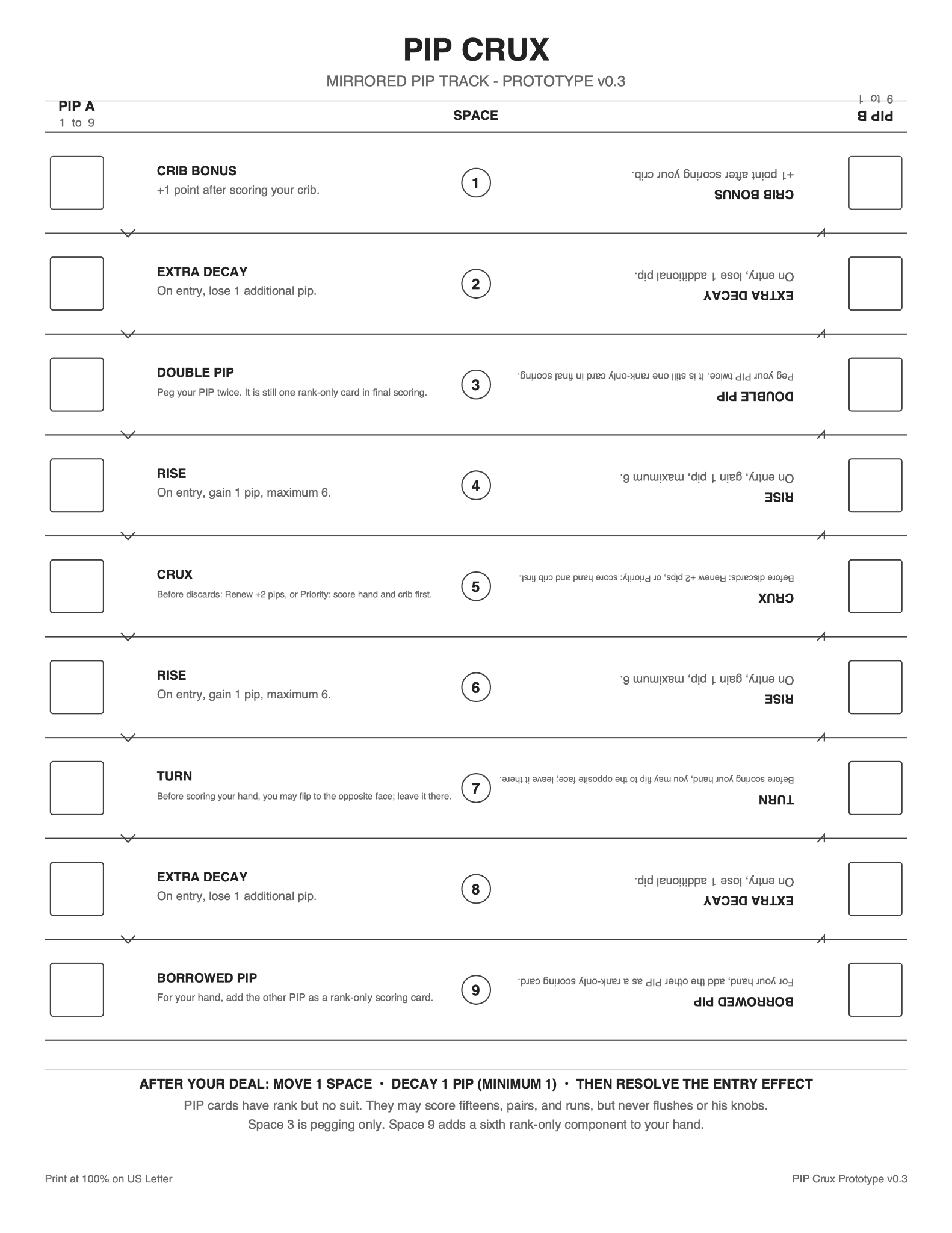
Place the player board between the players with PIP A moving from space 1 toward 9 and PIP B moving from space 9 toward 1. The board is mirrored so each player can read their own track.
Deal and Crib
The dealer deals four cards to each player. Players may look at their cards. If the dealer's PIP die is on space 5, they choose its effect now, after seeing their four cards but before either player discards.
Each player places one card face down into the dealer's crib and keeps the other three cards. The non-dealer cuts the remaining deck. Reveal the starter card. If the starter is a Jack, the dealer scores 2 points for his heels.
For final scoring, each player has three kept cards, their own PIP die, and the starter card. The dealer's crib has two discarded cards, both PIP dice, and the starter card.
Pegging
The non-dealer starts pegging. Follow normal Cribbage rules for fifteens, pairs, runs, go, and 31. In addition to their three kept cards, each player must play their own PIP die once during pegging.
When playing the die, announce its current value and add that value to the running count. A PIP play is treated as a card of its current rank. For example, a PIP 4 may make a pair with a played 4 or complete a 2-3-4 run. You may not play a PIP if its value would take the running count above 31.
A player whose PIP is on space 3 plays their PIP value twice as two separate pegging plays. This may give that player five total pegging plays: three cards and two PIP plays. If a player reaches the game-end score during pegging, they win immediately.
Scoring Hands and Crib
After pegging, score in this order unless space 5 changed it: non-dealer's hand, dealer's hand, then dealer's crib. Score fifteens, pairs, runs, and his knobs normally.
For flushes, ignore all PIP dice. A player hand scores a four-card flush only if their three kept cards and the starter are all the same suit. The crib cannot score a flush. A Jack among a player's kept cards or in the crib scores his knobs if it matches the starter's suit. PIP dice never score his knobs.
If a player reaches the game-end score during hand or crib scoring, they win immediately. Do not continue scoring the deal.
PIP Track Effects
The dealer uses the effect of the space occupied by their PIP die during that deal.
| Space | Effect |
|---|---|
| 1 | Crib Bonus: After scoring your crib, score 1 additional point. |
| 2 | Extra Decay: On entry, lose 1 additional pip. |
| 3 | Double PIP: During pegging, play your PIP die's current value twice as two separate PIP plays. This applies only during pegging; for final hand and crib scoring, your die remains one normal rank-only card. |
| 4 | Rise: On entry, gain 1 pip, to a maximum of 6. |
| 5 | Crux: After seeing your four dealt cards but before either player discards, choose one: Renew , gain 2 pips to a maximum of 6; or Priority , if neither player wins during pegging, score your hand first after pegging, then score your crib before the non-dealer scores their hand. |
| 6 | Rise: On entry, gain 1 pip, to a maximum of 6. |
| 7 | Turn: Before scoring your hand, you may flip your PIP die to its opposite face. If you do, use the new value for your hand and any later crib scoring. Leave the die showing its new face for future deals. |
| 8 | Extra Decay: On entry, lose 1 additional pip. |
| 9 | Borrowed PIP: When scoring your hand, also use the other player's current PIP value as an additional rank-only card. It may participate in every distinct legal fifteen, pair, and run, but cannot help make a flush or score his knobs. It does not change the other player's die. |
Advancing the PIP Track
After all hand and crib scoring is complete, the dealer advances their PIP die one space in their assigned direction. When advancing:
- Move the die one space.
- Decrease its showing value by 1, to a minimum of 1.
- Apply any additional movement effect of the destination space.
Only spaces 2, 4, 6, and 8 alter the die immediately upon entry. Spaces 1, 3, 5, 7, and 9 are active during their owner's next deal. Pass the deal to the other player.
FAQ
Questions and clarifications
Does Double PIP give me two PIP dice in my hand?
No. Space 3 gives you one additional PIP play during pegging only. Your final hand still includes one PIP die.
Can a PIP score more than one combination?
Yes. A PIP works like any normal card of that rank. For example, if your PIP is a 5, the starter is a 10, and you hold a King, the PIP scores two fifteens: 5 + 10 and 5 + King.
Does Borrowed PIP give me a sixth scoring component?
Yes. On space 9, your hand has your three kept cards, your own PIP die, the other player's PIP value, and the starter. The borrowed PIP is a rank-only card and may be used in all legal fifteens, pairs, and runs.